

reading people 101
it's not a vibe, it's a learnable skill

As psychic as I wish I was, the real expert in my life is my mom. She is psychic in the way that only immigrant mothers are: surgically perceptive, able to discern strikingly specific details about someone from just a photo. As a mother, she is of course principally concerned with whether the people in my life are good-natured— is this person kind, or are they someone who could hurt my daughter? But she can read other things too: sharpness, resilience under pressure, honesty.
Over the years, I’ve shown her photos of new friends I’m making, coworkers, and boys I’m considering seriously dating, and she’ll give me specific predictions on their character. Only now, as I’ve gotten older, I can see how many of these predictions have come true (especially about the ex-boyfriends, to my chagrin).
I’ve asked her countless times how she does it. I can’t explain it, she’ll say, it’s just a feeling I get. Or occasionally she’ll say something about the eyes, which is also vague.
This is my attempt to pass along everything I’ve learned from her.
Reading people 101
Before we dive into the how, I also want to talk about why this is important. Choosing your inner circle, your life partner and your closest confidants, is the most important choice you make in life. This is obvious. But too often, especially as young adults, we overindex on someone’s intelligence or ambition or ability to succeed. Don’t get me wrong, I’ll be the first to admit that smarts are incredibly sexy, but I do think in the long-term intelligence matters less (past a critical threshold).
Instead, kindness and caring and loyalty matter much more in the long-run. You can rest easy for a lifetime knowing someone will do right by you, not only because they love you but because it is in their nature to do so.
So let’s talk reading people 101. Better know right off the bat if someone is shifty instead of learning your lesson the hard way. First, this chart:
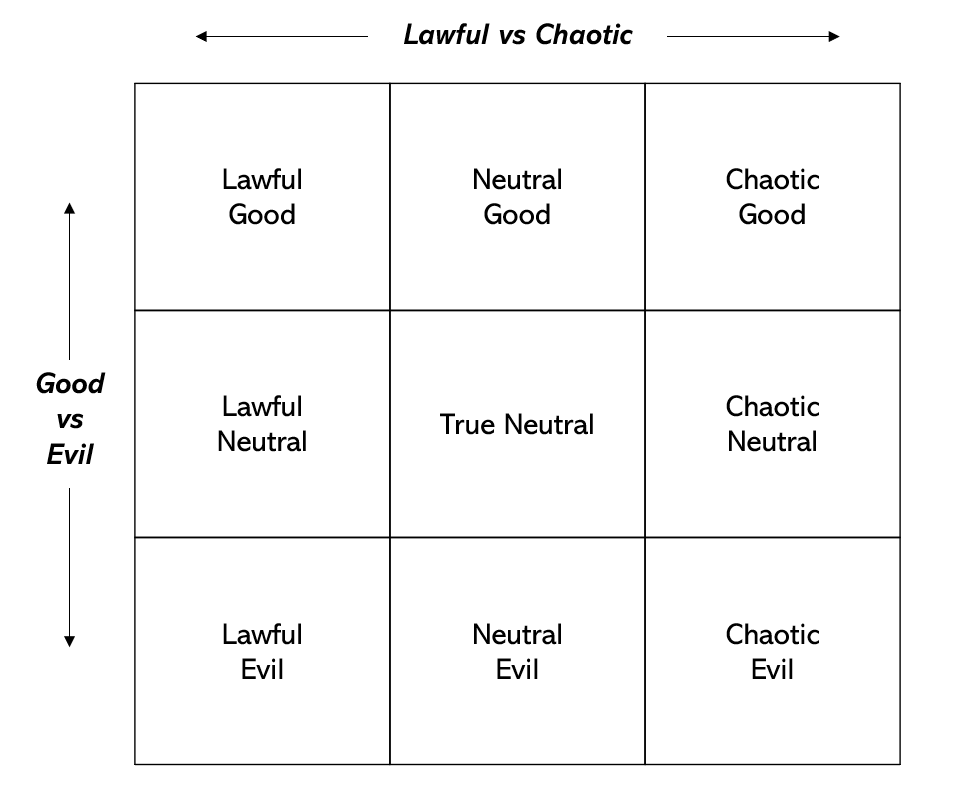
You might recognize this from the memes. Specifically, let me draw your attention to the Good-Neutral-Evil axis. Here’s how I think of the definitions:
Good: Actually wants to help you even if they don’t benefit. Will never wish ill on you, not really in their nature
Neutral: Will help you if it’s convenient or mutually beneficial. Won’t go out of their way to screw you, but won’t protect you either
Evil: May help you when interests align, but will actively screw you over if it benefits them
If you have any sort of sense of intuition (which you do), reading these definitions should have instinctively made you think of certain people in your life. Pay attention to that!
Goodness doesn’t exist in a vacuum. It shows itself in the real world when people want different things:
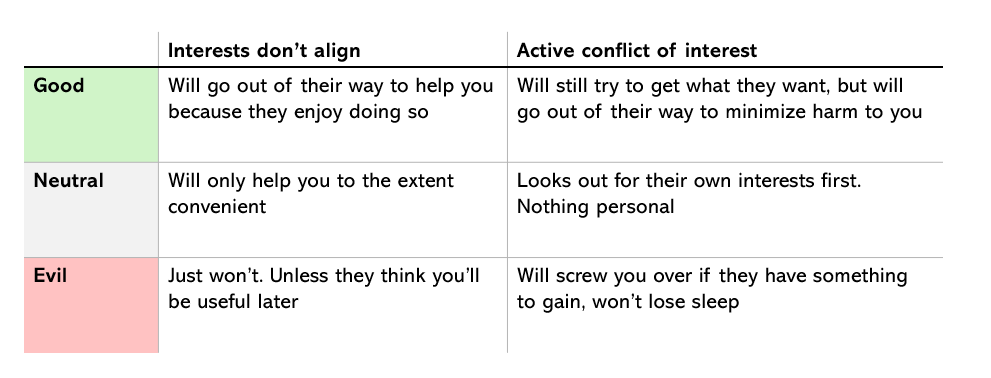
This is the real test. What happens when your interests no longer align? How do they treat you when they no longer owe you something?
Now, how to read people
The thing about people is that they tell you who they are. How they think is infused in practically everything about them, from the questions they ask (or don’t) to their casual comments to their tone of voice. You don’t need to watch particularly closely for people to reveal themselves to you, but you do need to watch consciously.
The most obvious signs are how they treat the people around them. How do they talk about their friends? How much fondness or affection or care comes across? A great signal is how they talk about their ex-lovers, or frankly, anyone they’ve had prior conflict with. How willing are they to consider the other’s side when it conflicts with their own? To advocate for the needs of others in a morally ambiguous or zero-sum situation? Even if they aren’t chatty, you should be able to feel warmth when they speak.
Listen to how they talk about themselves, too. If someone mentions that they feel like they are not a good person, or struggle with being selfish, then it’s probably true. Again, people tell you who they are. Working on becoming a better person is not the same as being a good person. It just means they have a gap so wide that it’s become obvious. The effort to improve is commendable, but it’s not the same thing.
And lastly but just as important, the nonverbal signals! For example, their facial expressions: how guarded are they? How big is their smile, how open is their laughter? And their eyes– is there light in their eyes?
Most importantly, do you feel that they have good intentions? Or do they have little regard for you? Even if you just met, do you sense that they wish you well?
Do not use your brain! Your brain is good for rational thinking. Trust your gut on this, your body, your soma. Your body has evolved now for hundreds of thousands of years to be able to figure out if people are good or not, honest or not, as this was instrumental to our survival as a social species. So yeah, all that wisdom lives somewhere very archaic in your body, which makes it all the more accurate. Use it.
Intuition as a practicable skill
When I was a kid, I was impressed with how my dad seemed to know exactly how many seconds to stick leftovers in the microwave. This seemed like witchcraft. How do you do that? I asked. You practice, he said sagely. You just guess how many seconds something takes, and gradually you get better at guessing.
Guess and practice, indeed. Like any skill, intuiting someone’s goodness is a practice of refining one’s guesses. When you first meet someone, you should have a hypothesis. Are they selfish? Honest? Do they seem to care for the wellbeing of others, or is this an afterthought?
Building intuition via guessing is something you’ve done before, because likely you’ve done it with intelligence. Think about it. Guessing the intelligence of others based on first encounters is something a lot of us do and are quite good at, because we’ve had a lot of practice doing so. We do it at school, then we do it at work, and we get instant feedback from knowing other people’s grades or their place of work or other proxies.
You can do the same with moral character. And with time, as you get to know them and see how they treat others, you will have your answers. You might find that you were right, or that maybe they surprised you. And in every case, with every meeting, your intuition will only get sharper.
As for myself, I live in Manhattan and am blessed to encounter many kinds of people basically all the time. I’ve also lived in California, and before that the American South, and sometime in between all of this I solo-backpacked abroad for half a year.
This is all to say: meeting different kinds of strangers and making snap-second judgments is a skill well-practiced for me. But it’s also a skill well-practiced for you, too. Think of all the people you’ve encountered in life, from school to work to your commute to the person bagging your groceries. We are constantly in a flux of meeting strangers, some of whom we will be lucky enough to call our best friends and future spouses. So it’ll always be important to be able to see, in these strangers’ eyes, if they are someone who will be good to you, for now and for forever onwards.
I've always prided myself on getting a good read on people from the first encounter. Sometimes I go against my gut and let people in that I knew I shouldn't have and it very rarely works out. I'm not sure if I could do it from a picture though! Your mom has hot me beat!
I found the 2x2 helpful. Thanks for posting this article. I am 1% better 🙏